A failure in a residential system is an inconvenience. A failure in a school, campus, or hotel can interrupt operations, displace occupants, and create serious health and safety risks.
This in-depth guide explores commercial boiler system design for educational and hospitality facilities, covering system selection, redundancy strategies, energy efficiency, domestic hot water production, mechanical room planning, Ontario code compliance, and long-term lifecycle reliability. It is written for engineers, facility managers, developers, and mechanical contractors responsible for large institutional buildings across Ontario and Canada.
1. Why Schools, Universities & Hospitality Buildings Are Unique Heating Environments
Unlike office buildings or retail spaces, educational and hospitality facilities operate under complex and high-risk conditions:
- High occupant density
- Variable but intense domestic hot water (DHW) demand
- Zero tolerance for heating interruptions
- Strict inspection and regulatory oversight
- Long operating hours—often 24/7
Schools require consistent space heating during occupied hours, while universities may operate year-round with residences, labs, recreation centres, and cafeterias. Hotels add another layer of complexity with continuous DHW demand for guest rooms, laundry, kitchens, spas, and pools.
Because of these demands, boiler systems in these buildings must be designed for:
- Reliability and system redundancy
- High efficiency at both full and partial loads
- Integration with building automation systems (BMS)
- Long service life and predictable maintenance costs
2. Heating Load Profiles: Schools vs Universities vs Hospitality
Understanding load behaviour is fundamental to correct boiler selection and system design.
Schools
- Peak space heating during early mornings and winter months
- Predictable schedules
- Reduced load on evenings, weekends, and summer
- Moderate domestic hot water demand
Universities & Colleges

- Mixed-use loads across classrooms, residences, labs, gyms, and dining
- Year-round heating and DHW demand
- Large distribution networks with complex zoning
- Campus-wide central plants common
Hotels & Hospitality
- Extreme DHW demand, especially mornings and evenings
- Laundry, kitchens, pools, and spas create high recovery requirements
- Continuous occupancy in many facilities
- Load diversity requires high turn-down ratios and fast response
Each of these profiles demands different boiler plant strategies, even when buildings appear similar in square footage.
3. Boiler Types Used in Educational & Hospitality Facilities
Modern institutional boiler plants typically use one or a combination of the following:
Condensing Gas Boilers
- High efficiency (up to 95%+)
- Modulating burners
- Best suited for low-temperature hydronic systems
- Ideal for schools and hotels with proper return water temperatures
Modular Boiler Plants
- Multiple smaller boilers staged together
- Integrated lead-lag operation
- Built-in redundancy
- Excellent seasonal efficiency
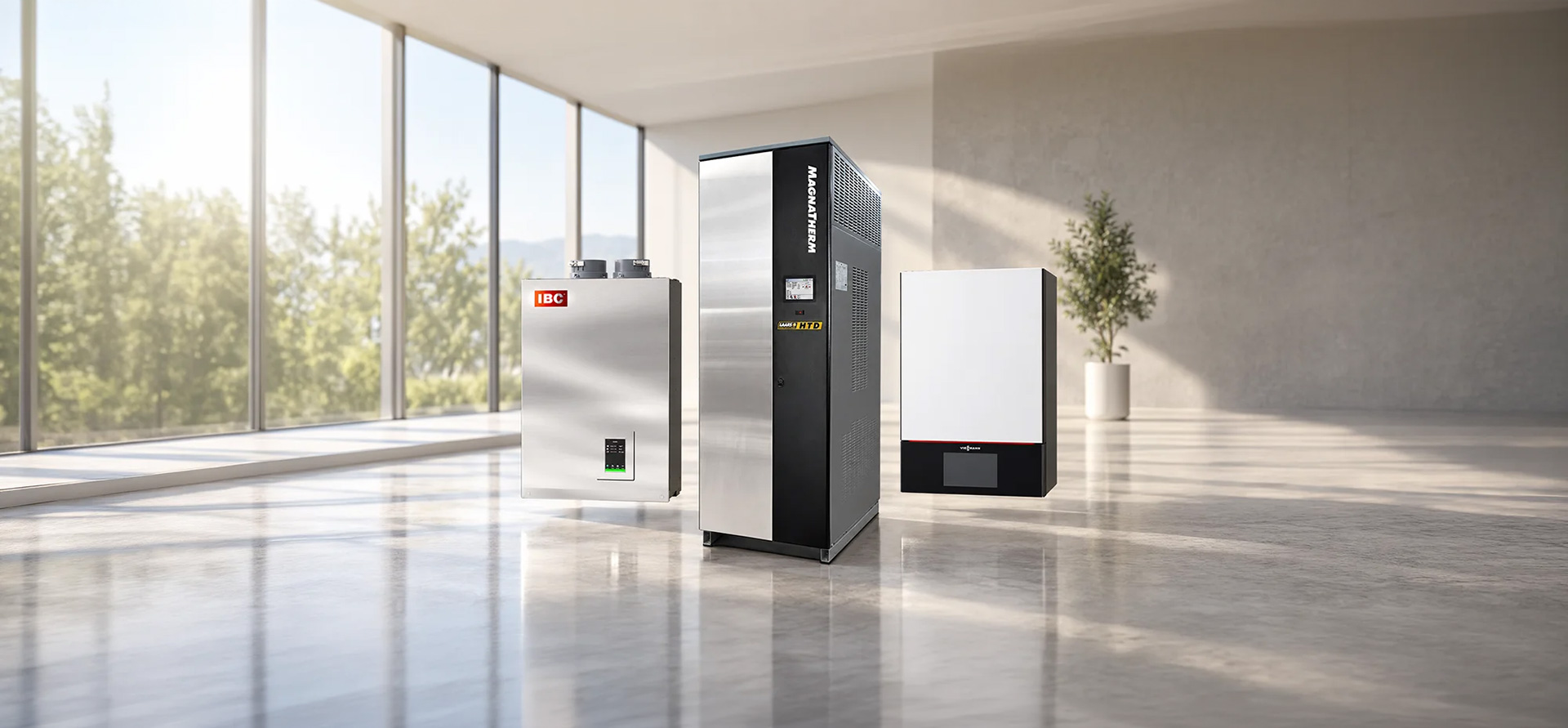
Many institutional projects use modular condensing boilers from manufacturers such as Laars, whose commercial boiler platforms are widely applied in educational, hospitality, and industrial environments due to their scalability, control flexibility, and long field-proven reliability.
Electric Boilers (Supplemental or Primary)

- Used where gas service is limited or decarbonization targets apply
- Often paired with heat pumps or gas boilers in hybrid systems
- Increasingly used on university campuses pursuing net-zero goals
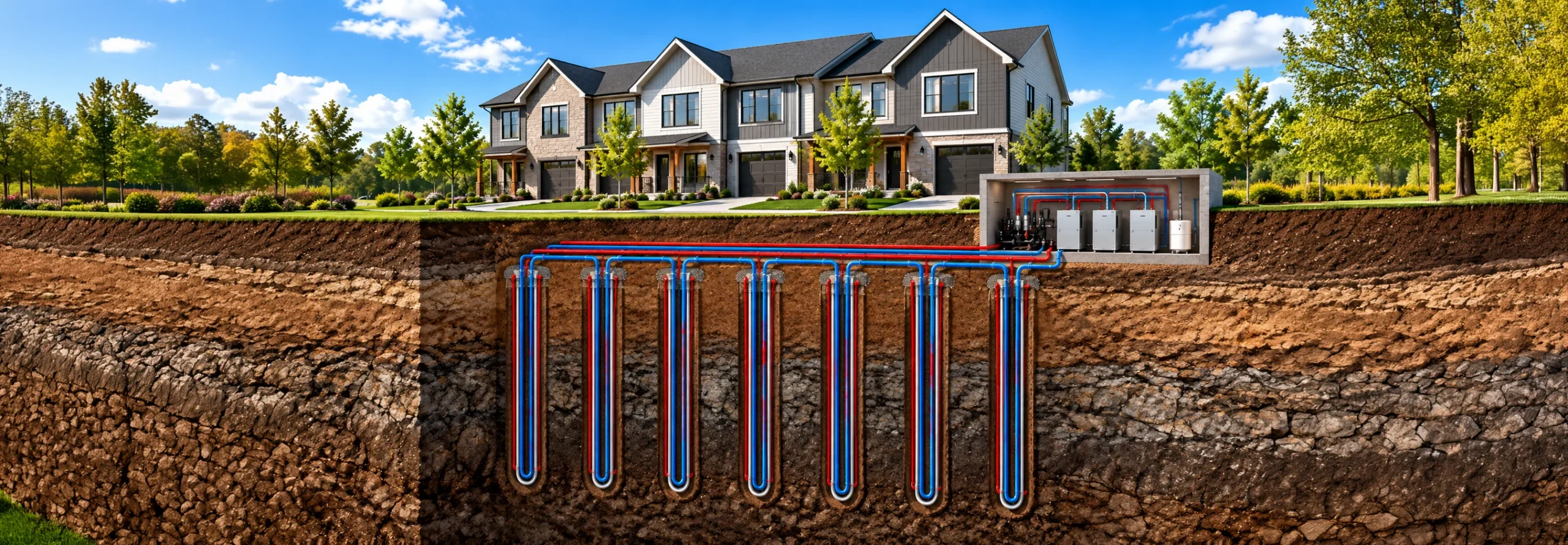
Hybrid Boiler + Heat Pump Systems
- Heat pumps provide low-temperature heating
- Boilers handle peak loads and extreme cold
- Growing rapidly across Ontario due to electrification policies
4. Domestic Hot Water (DHW): The Critical Factor in Hospitality
In hotels, DHW performance is often more critical than space heating. Guest comfort, hygiene, and health depend on uninterrupted hot water availability.
Key DHW design considerations include:
- Peak hourly draw during morning guest usage
- Rapid recovery times
- Recirculation loop balancing
- Legionella prevention through temperature control
- Storage vs instantaneous production strategies
Most hospitality systems combine:
- High-capacity boilers for DHW generation
- Storage tanks sized for peak demand
- Continuous recirculation to ensure instant hot water at fixtures
Improper DHW sizing is one of the most common causes of guest complaints and system retrofits in hotels.
5. Redundancy, Lead-Lag & N+1 Design Strategies
Educational and hospitality buildings cannot tolerate full system outages. As a result, boiler plants are almost always designed with redundancy.
Lead-Lag Operation
- One boiler operates as the primary (lead)
- Secondary boilers assist during peak loads
- Rotation equalizes runtime and wear
N+1 Redundancy
- One additional boiler above the required capacity
- Allows full operation even if one unit fails
For example, a campus requiring three boilers to meet design load may install four units to ensure continuous service under all conditions.
This approach is now considered best practice for:
- Schools
- Hospitals
- Universities
- Hotels
- Retirement residences
6. Piping Configuration & Hydraulic Separation
Correct piping design has as much impact on system performance as the boilers themselves.
Common institutional configurations include:
- Primary-secondary piping
- Hydraulic separators
- Low-loss headers
- Variable flow pumping strategies
These methods ensure:
- Stable boiler flow rates
- Proper temperature control
- Reduced thermal stress on heat exchangers
- Improved condensing performance
Improper piping is a leading cause of:
- Short-cycling
- Poor heat transfer
- Premature boiler failure
7. Energy Efficiency & Operational Cost Control
Institutional facilities face massive long-term energy costs, making efficiency a central design priority.
Key efficiency strategies include:
- Condensing operation with low return water temperatures
- Outdoor reset controls
- Load matching through modulation
- Zoning and variable flow distribution
- Sequencing optimization in modular plants
- Building automation (BMS) integration
It is important to note that nameplate efficiency is not the same as seasonal efficiency. A well-designed 92% efficient system can outperform a poorly designed 95% system in real-world operation.
8. Controls & BMS Integration

Schools and universities increasingly rely on centralized building automation systems to monitor and control HVAC equipment.
Modern boiler plants integrate with BMS for:
- Temperature reset control
- Boiler staging and sequencing
- Alarm reporting
- Energy monitoring
- Runtime equalization
- Fault diagnostics
Hotels use similar strategies but often place added emphasis on DHW controls, recirculation management, and guest zone monitoring.
Well-integrated control systems reduce:
- Energy waste
- Equipment stress
- Emergency service calls
- Long-term maintenance costs
9. Ontario Code & TSSA Compliance for Institutional Boilers
Commercial boiler systems in Ontario are subject to multiple layers of regulation, including:
- Ontario Building Code (OBC)
- TSSA gas safety regulations
- CSA B51 pressure vessel code
- ASME boiler requirements
- Local fire protection requirements
Key compliance areas include:
- Boiler room combustion air
- Mechanical ventilation
- Gas piping & shut-off systems
- Pressure relief valves and discharge piping
- Expansion tanks
- Backflow prevention
- Emergency shutdown controls
- Annual inspections and certifications
Educational and hospitality facilities are often inspected more frequently than standard commercial buildings due to public occupancy classifications.
10. Mechanical Room Design for Institutional Boilers
Mechanical room layout directly affects:
- Service accessibility
- Equipment lifespan
- Safety compliance
- Emergency response capability
Proper design includes:
- Clear service aisles
- Overhead lifting clearance
- Floor drainage and leak containment
- Ventilation air supply
- Noise and vibration control
- Separation of gas, electrical, and water services
In retrofits, mechanical room constraints often dictate modular boiler selection due to limited access and reduced footprint.
11. Maintenance & Lifecycle Planning
Institutional boiler systems are long-term infrastructure investments. Proper maintenance planning protects that investment.
Typical maintenance schedule includes:
- Annual combustion analysis
- Heat exchanger inspection
- Flue and vent inspection
- Expansion tank testing
- Safety device testing
- Control calibration
- Water quality testing
With proper maintenance:
- Commercial boilers typically last 20–30 years
- Control systems and pumps may require replacement sooner
- Neglected systems often fail in under 10–15 years
For schools and universities, predictive maintenance strategies are increasingly used to prevent in-season failures.
12. Retrofit vs Full Replacement Decisions
Many institutional buildings in Ontario still operate boilers that are 30–40 years old. Deciding whether to retrofit or replace is a critical financial and engineering decision.
Retrofit Often Makes Sense When:
- Distribution piping is in good condition
- Building envelope has been upgraded
- Gas service capacity is limited
- Budget constraints exist
Full Replacement Is Preferred When:
- Efficiency targets are aggressive
- Carbon reduction is mandated
- Frequent breakdowns occur
- Spare parts are no longer available
- Building use has changed significantly
Hybrid retrofits combining existing distribution with modern condensing or electric boilers are becoming common in education and hospitality projects.
13. Decarbonization & Net-Zero Pressures
Universities and public school boards are now at the forefront of carbon reduction initiatives across Canada. Many institutions have adopted:
- Net-zero carbon targets
- Electrification mandates
- District energy strategies
- Carbon pricing-driven financial models
As a result, traditional boiler plants are being augmented or replaced by:
- Heat pump pre-heating systems
- Electric boiler backups
- Thermal storage tanks
- Solar thermal integration
While gas boilers remain essential for peak demand and extreme cold, hybrid systems now dominate new institutional designs.
14. Common Failure Modes in Institutional Boiler Systems
From real-world field data, institutional boiler failures most often result from:
- Poor water quality management
- Improper venting design
- Incorrect combustion air sizing
- Faulty control integration
- Inadequate redundancy
- Deferred maintenance
These issues rarely stem from equipment quality alone. In most cases, failure is the result of system design or operational deficiencies.
15. Role of Manufacturers in Institutional Projects
Commercial boiler manufacturers play a critical role beyond just equipment supply. In institutional and hospitality projects, manufacturers often provide:
- Engineering sizing support
- BIM and specification documentation
- Control integration coordination
- Commissioning assistance
- Long-term technical support
Manufacturers such as Laars, with extensive commercial boiler portfolios, are widely specified in institutional and hospitality projects due to their ability to support complex system designs, modular plant architectures, and long operational lifespans.
16. Contractor & Engineer Coordination
Successful school, university, and hotel boiler projects rely on tight coordination between engineers, mechanical contractors, electricians, and controls specialists.
Critical coordination points include:
- Flue routing and structural penetration planning
- Electrical service capacity
- Control wiring and network integration
- Gas service upgrades
- Commissioning sequencing
- Phased changeouts to avoid operational downtime
Poor coordination is a leading cause of project delays and operational failures.
17. Emergency Preparedness & System Resilience
Institutional heating systems must be designed for emergency operation. Best-practice strategies include:
- Backup power for pumps and controls
- Emergency boiler enable circuits
- Remote alarm monitoring
- Manual override capability
- On-site spare parts inventory
These measures are particularly critical for:
- Student residences
- Winter hotel operations
- Remote campuses
- Long-term care residences
18. Future Trends in Institutional & Hospitality Boiler Systems
Key trends shaping the next decade include:
- Rapid growth of electric and hybrid boiler plants
- Integration with campus energy networks
- AI-driven predictive maintenance
- Smart metering and energy dashboards
- Carbon-driven equipment selection
- Prefabricated mechanical skids
As energy policy continues to evolve across Canada, schools and hospitality facilities will remain at the forefront of advanced boiler system deployment.
Final Thoughts
Commercial boiler systems for schools, universities, and hospitality buildings represent some of the most demanding and technically complex heating applications in the HVAC industry. These facilities require:
- Absolute reliability
- High efficiency
- Redundant operation
- Code-compliant safety
- Long-term serviceability
From condensing modular boiler plants and sophisticated DHW systems to hybrid electrification strategies and campus-wide automation, modern institutional boiler design is a highly specialized discipline.
Facilities that invest in proper system design, quality equipment, professional installation, and disciplined maintenance consistently achieve lower operating costs, fewer failures, and longer equipment life
If you require technical guidance, sizing support, or equipment coordination for any commercial boiler application in schools, universities, or hospitality buildings, the team at Nordics is always here to support your commercial projects. We work closely with engineers, contractors, and facility managers across Ontario to ensure boiler systems are properly selected, specified, and delivered to meet complex project requirements. For technical assistance or project inquiries, simply contact us and our commercial HVAC specialists will be glad to assist.