Geothermal, more accurately called a ground-source heat pump, has been around for decades. It never disappeared. It simply remained a more specialized part of the HVAC market because the installation is more involved, the upfront cost is higher, and not every property is a good candidate.
That doesn’t make it irrelevant.
For contractors already working with heat pumps, geothermal represents another type of project with a very different set of advantages, design considerations, and installation requirements.
Ontario incentive programs also include qualifying ground-source systems, which gives homeowners another reason to start asking contractors about the technology.
And with Airquest adding geothermal equipment such as the HBR Performance Multi-Speed Geothermal Heat Pump, contractors now have another equipment option to consider when the application makes sense.
Geothermal Is Still a Heat Pump
The word “geothermal” can make the technology sound more complicated than it really is.
A residential geothermal heat pump is not drilling kilometres underground looking for steam or extreme heat.
The basic refrigeration cycle is still familiar HVAC territory.
A conventional air-source heat pump exchanges heat with the outdoor air. A ground-source heat pump exchanges heat with the ground, groundwater, or both.
During heating, the system absorbs thermal energy from the ground and transfers it into the building.
During cooling, the process reverses. Heat is removed from the building and transferred back into the ground.
The major difference is the temperature of the heat source.
Outdoor air temperatures in Ontario can change dramatically throughout the heating season. Underground temperatures are much more stable.
That gives geothermal systems a relatively consistent heat source during winter and a heat sink during summer.
It doesn’t mean geothermal automatically performs better in every application. It means the equipment operates under very different conditions than an air-source heat pump.
The Ground Loop Changes the Entire Project
For a contractor familiar with furnaces, air conditioners, and air-source heat pumps, the indoor equipment is only part of a geothermal system.
The other major component is the ground heat exchanger.
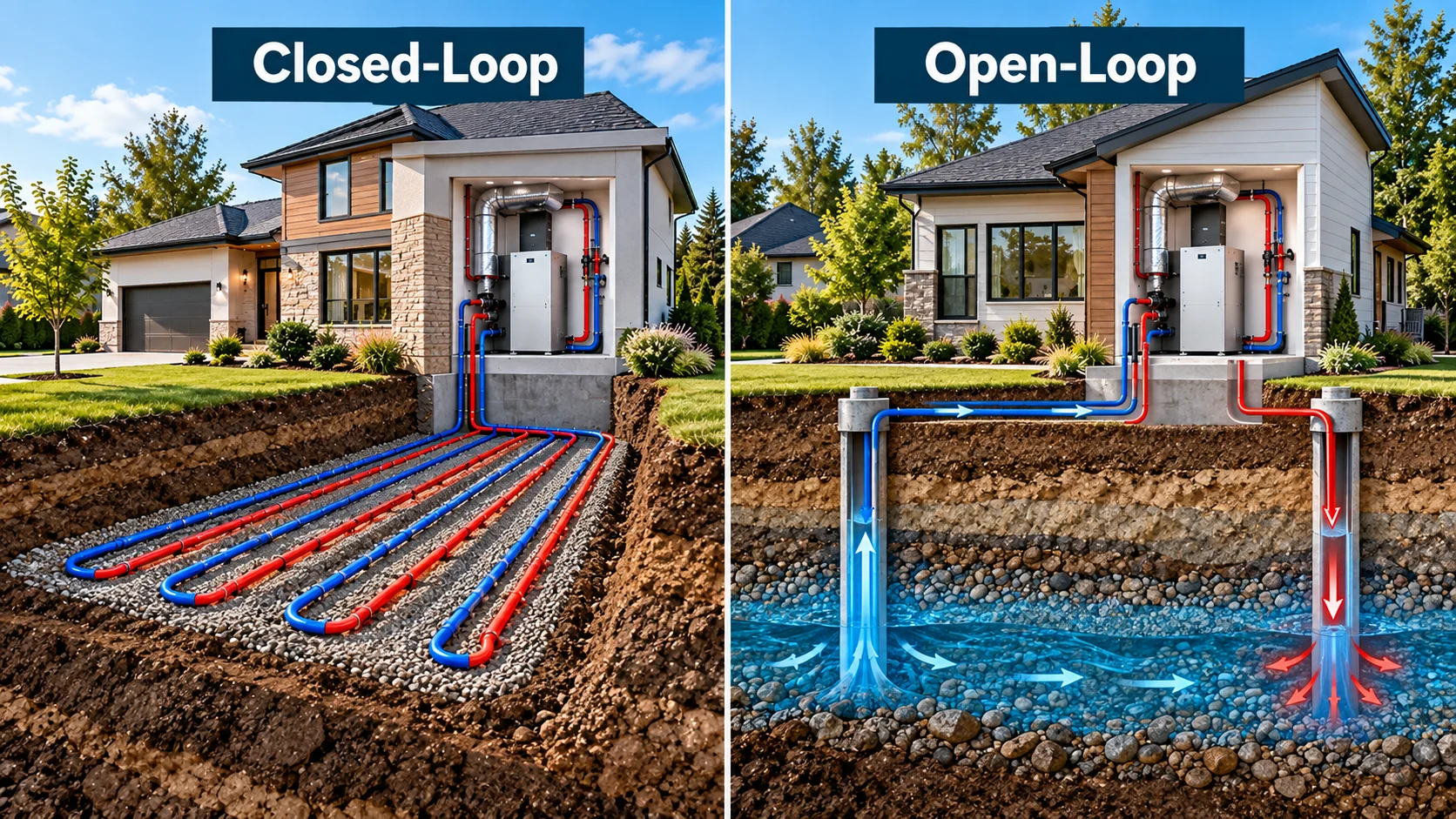
There are two common approaches contractors will hear about: closed-loop and open-loop systems.
Closed-Loop Systems
A closed-loop geothermal system circulates fluid through buried piping.
Depending on the property and system design, that piping may be installed using:
- Horizontal trenches
- Vertical boreholes
- Pond or lake loops
- Other engineered loop configurations
The fluid stays within the piping and transfers heat between the ground and the geothermal equipment.
Vertical systems can be useful when available land area is limited, while horizontal systems may make sense where sufficient property is available for excavation.
The correct approach depends heavily on site conditions.
Open-Loop Systems
An open-loop system uses groundwater directly as the heat-exchange medium.
Water is drawn from a suitable source, passed through the geothermal unit, and then discharged or returned according to the system design and local requirements.
Water quantity, water quality, local regulations, well conditions, and discharge requirements all become part of the project.
This is where geothermal becomes very different from replacing a furnace or installing an outdoor heat pump.
Soil conditions matter.
Available property matters.
Drilling or excavation may be required.
Water conditions can matter.
Loop design matters.
Building load matters.
The heat pump cannot be treated separately from the ground side of the system.
A properly selected geothermal unit connected to a poorly designed ground loop can still produce a poor-performing system.
Geothermal is not a category where guesswork belongs.
Why Ontario Weather Makes Geothermal Interesting
Air-source heat pumps have improved significantly, especially cold-climate equipment.
For many Ontario homes, they can be an excellent heating and cooling solution.
Geothermal takes a different approach to cold-weather performance.
Instead of extracting heat directly from outdoor air during extremely cold conditions, a ground-source system exchanges heat with the ground, where temperatures are comparatively stable.
That stability is one of the reasons geothermal can maintain strong heating performance during winter.
There is another obvious difference contractors will recognize immediately.
There is no outdoor coil sitting outside in snow, freezing rain, and changing winter conditions.
Air-source heat pumps periodically need to manage frost accumulation on the outdoor coil through defrost cycles.
Ground-source systems do not operate with that same outdoor-air heat exchanger.
That does not make geothermal maintenance-free.
Pumps, filters, airflow, water flow, controls, refrigeration components, and system performance still need attention.
It simply removes one of the major environmental challenges associated with an outdoor heat pump.
Contractors Need to Understand COP and EER
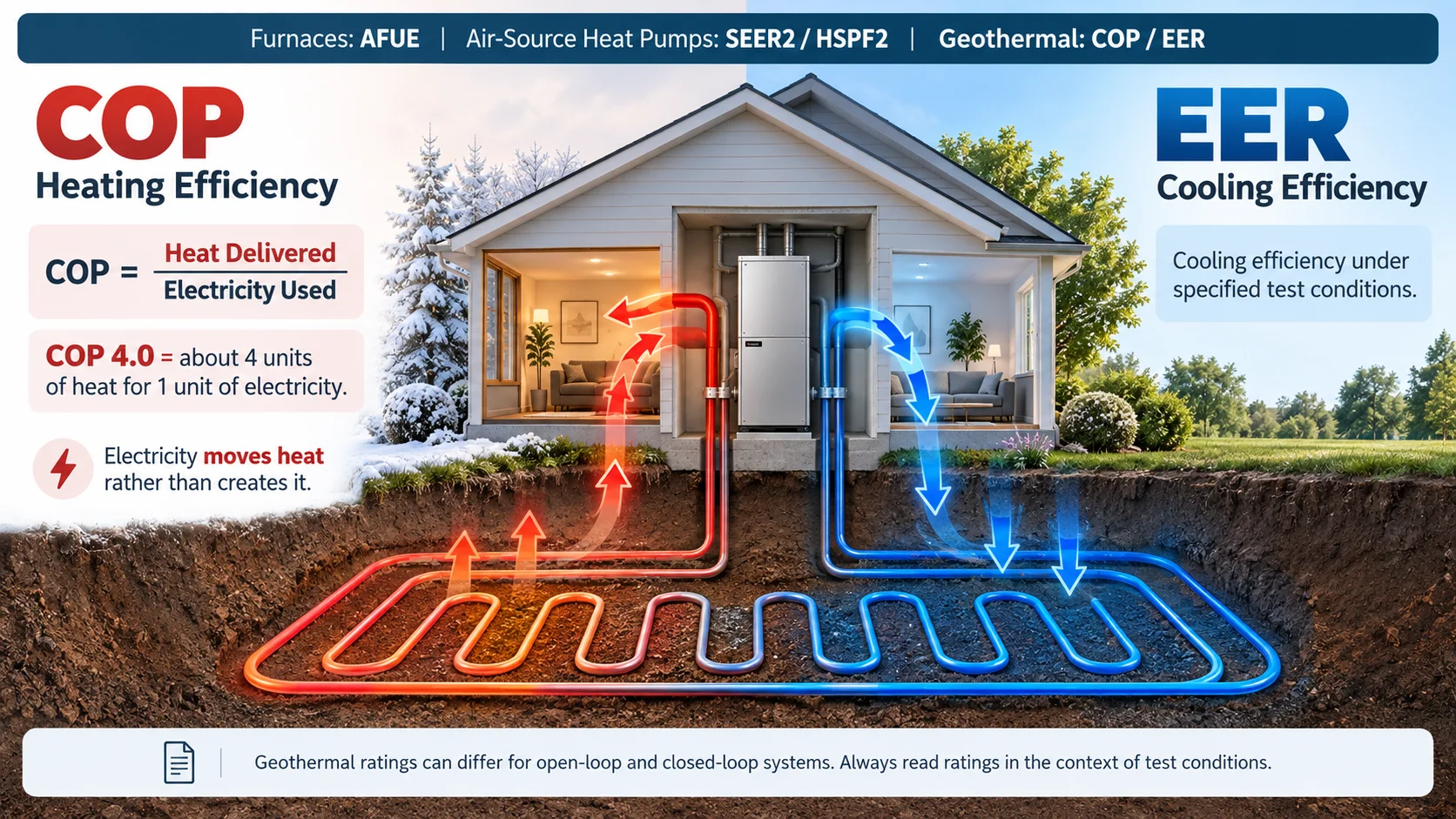
When talking about furnaces, contractors are used to AFUE.
For conventional air-source equipment, SEER2 and HSPF2 are common efficiency ratings.
Geothermal conversations often involve COP and EER.
COP
COP stands for coefficient of performance.
It compares the amount of heating energy delivered by the system with the electrical energy required to operate it.
For example, a COP of 4 means the system is delivering approximately four units of heat for every unit of electricity consumed under the specified test conditions.
That does not mean the equipment is somehow creating energy at 400% efficiency.
A heat pump uses electricity to move existing thermal energy from one place to another.
EER
EER is used to measure cooling efficiency under specified operating conditions.
With geothermal equipment, ratings can vary depending on whether the system is operating in an open-loop or closed-loop application.
That is important because published ratings should always be interpreted within the conditions under which the equipment was tested.
A Closer Look at the Airquest HBR
The Airquest HBR Performance Multi-Speed Geothermal Heat Pump brings the brand into a different part of the heating and cooling market.
The HBR is available in sizes ranging from 1.5 to 5 tons.
Models from 2 to 5 tons use two-stage compressor operation, while the 1.5-ton model uses single-stage operation.
The system also includes a multi-speed blower designed to help match airflow to the application.
Published heating efficiency ranges from approximately:
3.7 to 4.3 COP in closed-loop applications
and
4.3 to 5.2 COP in open-loop applications
Published cooling efficiency ranges from approximately:
18.5 to 21.7 EER in closed-loop applications
and
22.7 to 28.1 EER in open-loop applications
Actual system performance will depend on several factors, including ground-loop design, entering water temperature, airflow, water flow, equipment selection, building load, and installation quality.
The HBR also includes:
- R-454B refrigerant
- Factory-installed A2L refrigerant dissipation system
- Built-in 2-inch MERV 8 filtration
- Insulated cabinet
- Passive dehumidification
- Multi-speed airflow
- ENERGY STAR qualification across the HBR range
Available options include supplemental domestic hot-water generation, internally mounted auxiliary heat, and smart-start functionality.
These specifications matter, but geothermal still needs to be viewed as a complete system rather than simply another piece of HVAC equipment.
Correct load calculation, loop design, pumping, airflow, controls, auxiliary heat strategy, and commissioning all influence the final result.
A high-efficiency geothermal heat pump connected to a poorly designed system is still a poorly designed system.
The Upfront Cost Is Still the Biggest Barrier
There’s no point pretending otherwise.
Geothermal typically requires more work up front than an air-source heat pump installation.
The ground heat exchanger may require drilling, excavation, wells, trenching, specialized equipment, or additional contractors before the heat pump itself is commissioned.
That can significantly increase the initial project cost.
This is exactly why geothermal should not be presented as the automatic upgrade for every homeowner.
A small urban property with limited space may present very different challenges than a large rural property.
A homeowner planning to sell the house in two years may look at the economics differently from someone building a long-term custom home.
Ground conditions can also make one property significantly easier or more difficult than another.
The contractor’s job is to determine whether the application makes sense, not simply whether geothermal equipment can physically be installed.
At the same time, the ground loop itself can remain part of the mechanical infrastructure for a very long time when properly designed and installed.
That changes the long-term economics of the system compared with looking only at the initial installation price.
Rebates Are Giving Homeowners Another Reason to Ask
Ontario’s Home Renovation Savings program includes incentives for qualifying ground-source heat pump installations.
Depending on the home’s existing heating system and current program requirements, eligible homeowners may qualify for financial incentives toward a geothermal installation.
But contractors need to be careful with how rebates are discussed.
A geothermal system should never automatically be advertised as rebate eligible simply because it is a ground-source heat pump.
Eligibility can depend on:
- The homeowner
- The property
- The existing heating system
- The selected equipment
- The contractor
- Program requirements
- Required approvals
- Current rebate rules
Contractors should verify eligibility before promising a rebate or using the rebate amount as part of the final selling price.
Programs change.
Equipment lists change.
Eligibility requirements change.
The safest approach is simple: verify first, sell second.
Geothermal Projects Require More Planning
Geothermal installations can involve more coordination than conventional residential HVAC projects.
Depending on the project, the contractor may need to work with:
- Loop installers
- Drilling companies
- Excavation contractors
- Well specialists
- Electricians
- Designers
- Engineers
- Building departments
- Other trades
That coordination is part of the geothermal business model.
It also means contractors interested in geothermal should think beyond equipment selection.
They need to understand the entire project workflow.
Who designs the loop?
Who confirms the building load?
Who is responsible for drilling?
Who verifies water flow?
Who commissions the system?
Who handles controls?
Who owns responsibility if the system does not perform as expected?
These questions should be answered before the project begins.
Geothermal Probably Won’t Replace Air-Source
The HVAC industry has a habit of turning technologies into competitions.
Furnace versus heat pump.
Ductless versus ducted.
Air-source versus geothermal.
That is usually the wrong way to look at it.
Air-source heat pumps make sense for a huge number of applications because they can often be installed without drilling, trenching, or major site work.
They can also integrate into many existing homes relatively easily.
Geothermal serves a different part of the market.
Where the property, budget, building load, and installation conditions line up, geothermal can provide efficient year-round heating and cooling while relying on relatively stable ground temperatures rather than changing outdoor air conditions.
For contractors, that makes geothermal worth understanding even if it never becomes the majority of their installations.
The goal is not to sell geothermal on every job.
The goal is to recognize the projects where it deserves to be part of the conversation.
Contractors Should Start Paying Attention Now
Geothermal is not new technology.
What is changing is the environment around it.
Heat pumps are now a much bigger part of the HVAC conversation.
Homeowners are more familiar with electrification.
Rebate programs are encouraging customers to investigate different heating technologies.
And manufacturers continue to develop equipment for the ground-source market.
That combination means more homeowners, builders, and mechanical contractors are likely to start asking questions about geothermal.
For contractors who have never worked with it before, that doesn’t mean jumping straight into geothermal installations tomorrow.
It means learning how the systems work.
Understanding the difference between open-loop and closed-loop applications.
Learning how geothermal equipment is rated.
Understanding where ground loops fit into the project.
Knowing when the application makes sense.
And knowing when it doesn’t.
When the right geothermal project eventually comes through the door, understanding the technology before the customer asks for a quote puts the contractor in a much stronger position.
Airquest Geothermal at Nordics
Nordics now supplies Airquest geothermal equipment, including the HBR Performance Multi-Speed Geothermal Heat Pump.
For product information, equipment selection, availability, and technical support for an upcoming geothermal project, contact the Nordics team.
Rebate Disclaimer: Rebates are offered through applicable government or utility programs and are subject to current program rules, homeowner and property eligibility, participating contractor requirements, equipment qualification, and approval. Nordics does not administer, approve, guarantee, or issue rebates and accepts no responsibility for rebate approval or payment.