For HVAC contractors, those temperature swings raise an important question: What’s the best way to keep a home comfortable without relying on the same heating source all winter?
Dual-fuel heating is one option that’s worth a closer look.
By combining an electric heat pump with a natural gas furnace, a dual-fuel system can use different heating sources depending on outdoor temperatures, energy costs, and the home’s heating requirements.
It’s a particularly interesting option for Ontario homeowners who already have a gas furnace and are considering replacing their central air conditioner or upgrading their entire HVAC system.
With manufacturers such as Airquest, Bosch, and Panasonic offering equipment designed for dual-fuel or hybrid heating applications, contractors have more options when planning residential heating upgrades.
But getting the most from these systems involves more than connecting a heat pump to a furnace. Proper equipment matching, controls, sizing, and installation all play a role.
What Exactly Is Dual-Fuel Heating?
A dual-fuel heating system uses two different energy sources to heat a home, typically electricity and natural gas.
The electric heat pump provides heating when outdoor conditions are suitable. When temperatures drop or the controls determine that gas heating is more appropriate, the system switches to the furnace.
During warmer months, the heat pump reverses its operation and functions as an air conditioner, providing cooling through the home’s ductwork.
The transition between heating sources is managed by a compatible thermostat or system controller.
For homeowners, the process is largely automatic. They set their preferred indoor temperature, and the equipment operates according to the configured heating strategy.
For contractors, there’s more happening behind the scenes.
The system must account for heat pump capacity, outdoor temperature, furnace operation, airflow, and the appropriate changeover point.
In most conventional dual-fuel installations, the heat pump and gas furnace operate separately rather than producing heat simultaneously.
The objective is to select the heating source that best meets the building’s needs under the current conditions.
Why Dual-Fuel Heating Works Well for Ontario’s Climate
Ontario experiences a wide range of temperatures throughout the heating season.
In the Greater Toronto Area, including Vaughan, Richmond Hill, Markham, Mississauga, and surrounding communities, the weather can shift significantly between October and March.
During fall and early spring, a heat pump may be capable of handling much of the home’s heating demand.
Modern cold-climate heat pumps can also provide useful heating at temperatures well below freezing, although their performance varies by model and operating conditions.
As temperatures fall, the home’s heating demand increases. At the same time, the available heating capacity and efficiency of many air-source heat pumps decrease.
This is where having a second heating source can be useful.
A properly configured dual-fuel system can switch to the gas furnace when the heat pump cannot meet the load independently or when another operating strategy makes more sense.
Consider a homeowner with an existing high-efficiency gas furnace and an aging central air conditioner.
Instead of installing another conventional air conditioner, the contractor may be able to recommend a compatible central heat pump.
The homeowner gains electric heating capability during suitable conditions while retaining the gas furnace for colder weather.
This doesn’t mean every Ontario home needs dual-fuel heating. Some properties may be better suited to all-electric systems, particularly when equipped with properly sized cold-climate heat pumps.
However, for homes with existing natural gas infrastructure, dual-fuel heating can provide another practical route toward modernizing the heating and cooling system.
Understanding When the System Should Switch to Gas

One of the most important decisions in a dual-fuel installation is determining when the system should stop using the heat pump and start using the gas furnace.
It’s tempting to choose a fixed outdoor temperature and apply it to every installation, but that approach overlooks several important factors.
Every home has different heating requirements.
A well-insulated newer home may require much less heat than an older property with significant air leakage, even when both homes have similar floor areas.
Heat pumps also have different operating characteristics. One model may maintain more of its heating capacity at low temperatures than another.
Contractors should consider two concepts when configuring the system.
Thermal balance point: This is the outdoor temperature at which the heat pump’s available heating output matches the building’s heating demand. Below this point, the heat pump may not be able to maintain the desired indoor temperature on its own.
Economic balance point: This is the temperature at which the operating costs of the heat pump and furnace are approximately equal, based on their performance and applicable energy prices.
These balance points are not necessarily identical.
A heat pump might still have enough capacity to heat a home when operating the gas furnace becomes less expensive. In another installation, the heat pump may reach its capacity limit before the furnace becomes the cheaper heating option.
Electricity rates, natural gas prices, equipment efficiency, and control capabilities all influence the best operating strategy.
The important takeaway is that the changeover setting should be selected based on the actual system, not a universal temperature recommendation.
Can Dual-Fuel Heating Help Reduce Operating Costs?
It can, although the potential savings depend heavily on the installation and local energy prices.
Heat pumps operate differently from conventional heating equipment.
Rather than generating heat by burning fuel, an air-source heat pump transfers heat from outdoor air into the building.
Under suitable conditions, it can deliver several units of heating energy for every unit of electricity consumed.
This relationship is measured using the coefficient of performance, or COP.
For example, a COP of 3 means the heat pump delivers approximately three units of heat for every unit of electrical energy consumed under the specified test conditions.
However, a heat pump’s COP is not constant throughout winter. Outdoor temperature, defrost operation, equipment design, and other factors affect actual performance.
Gas furnaces use a different efficiency measurement called Annual Fuel Utilization Efficiency, or AFUE.
Comparing COP and AFUE alone doesn’t tell contractors which system will be cheaper to operate.
Ontario electricity rates, time-of-use periods where applicable, natural gas rates, and the home’s heating profile must also be considered.
Dual-fuel systems provide flexibility because the control strategy can be designed around these factors.
For homeowners, that flexibility can be attractive. For contractors, the opportunity is to recommend equipment based on actual heating requirements and operating conditions rather than promising a fixed percentage of energy savings.
Dual-Fuel Heating Options from Airquest, Bosch and Panasonic
HVAC contractors don’t have to rely on a single manufacturer when considering dual-fuel heating.
Several established HVAC brands offer central heat pump equipment designed for hybrid heating applications.
At Nordics, contractors can explore heating and cooling products from Airquest, Bosch, and Panasonic, with different options for residential installations, retrofits, and complete system replacements.
The important detail is that dual-fuel compatibility depends on the specific equipment combination. Not every heat pump, coil, furnace, or thermostat can be paired interchangeably.
Airquest Heat Pumps and Gas Furnaces
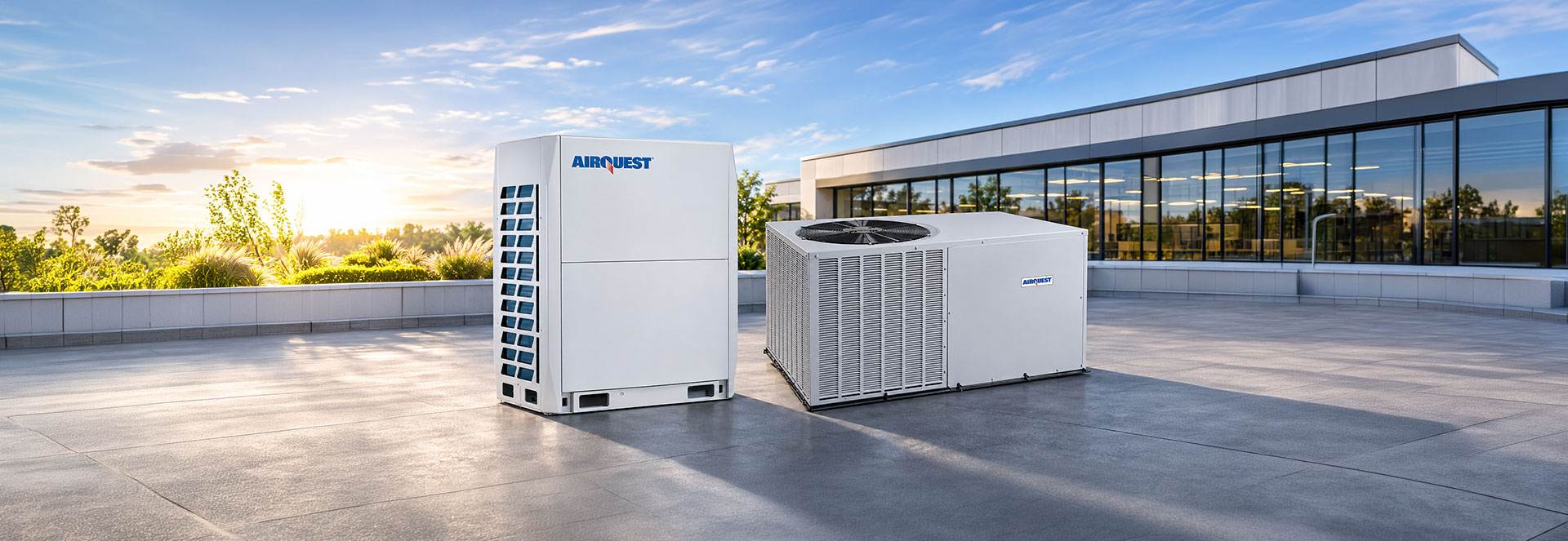
Airquest, a proud member of the Carrier family, offers a range of central heat pumps and gas furnaces for different residential applications.
Several Airquest heat pump series support dual-fuel configurations when matched with compatible furnaces and controls.
For example, the Airquest Ion variable-speed heat pump lineup includes models designed to adjust compressor operation as heating and cooling requirements change.
The Airquest H5H3V Ion 23 variable-speed heat pump is one example of a manufacturer-documented dual-fuel-capable model when paired with a compatible gas furnace and thermostat.
Airquest also offers Performance series heat pumps, including models intended for dual-fuel use with approved furnace and control combinations.
For contractors, these options make it possible to evaluate different equipment configurations depending on the home’s heating requirements, installation conditions, and project budget.
An Airquest heat pump paired with an appropriate gas furnace can provide central cooling, electric heating, and gas heating within one integrated system.
Contractors can explore Airquest heating and cooling equipment and Airquest gas furnaces available through Nordics.
Bosch IDS Heat Pumps for Dual-Fuel Applications
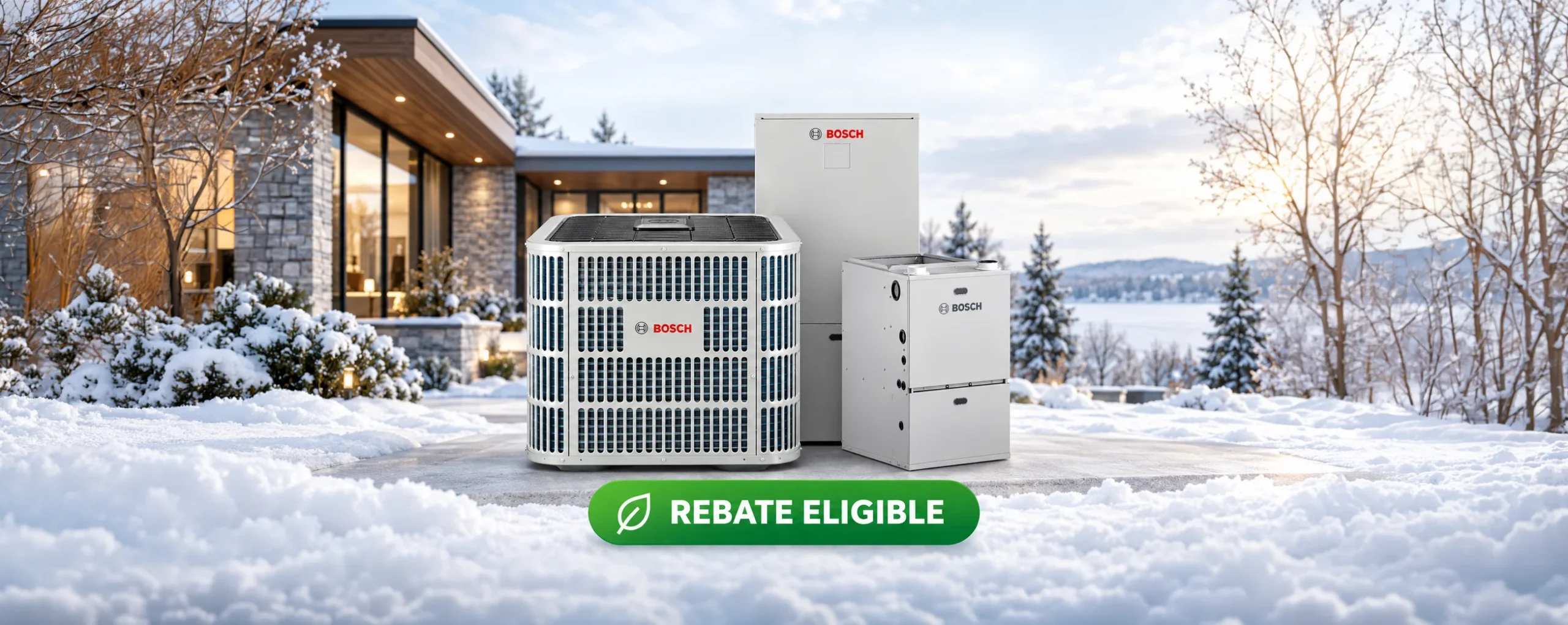
Bosch is another manufacturer offering equipment specifically designed for dual-fuel heating.
The Bosch Inverter Ducted Split (IDS) heat pump family uses inverter technology to adjust compressor operation based on heating and cooling requirements.
Unlike conventional single-stage systems that operate primarily at a fixed capacity, inverter-driven heat pumps can vary their output within their operating range.
This can help maintain more consistent indoor temperatures and reduce unnecessary cycling under suitable conditions.
Bosch documents dual-fuel configurations that combine compatible IDS heat pumps, indoor cased coils, and Bosch gas furnaces.
The Bosch BGH96 furnace, for example, is designed to integrate with approved Bosch IDS equipment in dual-fuel applications.
Bosch also provides compatibility and sizing information to help contractors select appropriate furnace and coil combinations.
For Ontario contractors, these systems are particularly relevant when replacing a conventional central air conditioner in a home that already uses forced-air gas heating.
However, installers still need to verify the selected equipment generation, refrigerant compatibility, controls, and manufacturer-approved combinations.
A heat pump and furnace carrying the same brand name are not automatically a certified match.
Explore Bosch IDS Central Heat Pumps and Bosch Furnaces through Nordics.
Panasonic INTERIOS Heat Pumps and Hybrid Heating
Panasonic offers central heat pump technology for both all-electric and hybrid heating applications.
Its INTERIOS lineup includes inverter-driven equipment designed to provide heating and cooling in demanding climates.
Panasonic also manufactures INTERIOS hybrid A-coil heat pump systems specifically designed to integrate with a compatible gas furnace.
In this type of configuration, the indoor A-coil and outdoor heat pump provide electric heating and cooling while the furnace remains available as a second heating source.
This approach can be particularly interesting for retrofit projects where contractors want to introduce heat pump technology without necessarily replacing every part of the existing forced-air heating system.
Panasonic also offers separate INTERIOS air-handler configurations with electric auxiliary heating options.
These should not be confused with its hybrid A-coil systems intended for gas furnace integration.
Contractors need to identify the correct INTERIOS configuration and verify furnace compatibility, approved controls, and applicable equipment specifications before designing a dual-fuel installation.
Nordics offers Panasonic INTERIOS Central Heat Pumps for Ontario HVAC applications. Contractors should contact the Nordics team to confirm which system configurations and components are available for their projects.
Why Proper Equipment Matching Matters

One of the biggest mistakes in dual-fuel system design is assuming that any central heat pump can be connected to any existing gas furnace.
In practice, several components must work together.
The outdoor heat pump, indoor coil, furnace blower, refrigerant system, and controls must be compatible and properly selected.
An older furnace may still be working perfectly well, but that doesn’t necessarily make it suitable for the proposed heat pump.
Contractors should verify whether the blower can deliver the required airflow and whether the duct system can handle the heating and cooling requirements of the new equipment.
The physical dimensions of the indoor coil also matter, particularly in tight mechanical rooms where installation space is limited.
Refrigerant compatibility is another important consideration, especially when replacing older R-410A equipment with newer systems designed for different refrigerants.
Manufacturer installation requirements, applicable refrigerant safety measures, and certified equipment combinations must be followed.
Controls deserve equal attention.
The thermostat or communicating control system needs to manage heating stages, outdoor temperature inputs, and transitions between the heat pump and gas furnace.
Poorly configured controls can cause unnecessary cycling, inefficient operation, or unexpected comfort problems.
Taking the time to verify these details during equipment selection is considerably easier than troubleshooting them after installation.
What Contractors Should Check Before a Dual-Fuel Installation
A reliable dual-fuel installation begins with a proper evaluation of the building and existing HVAC equipment.
Before selecting equipment, contractors should review the following:
- Heating and cooling load calculations: Determine the home’s actual heating and cooling requirements rather than relying solely on the capacity of the equipment being replaced.
- Existing furnace condition: Inspect the furnace, blower, heat exchanger, venting, and general service condition to determine whether retaining it is appropriate.
- Approved equipment combinations: Confirm heat pump, coil, furnace, and control compatibility using current manufacturer documentation.
- Ductwork and airflow: Measure or evaluate external static pressure, airflow capacity, and distribution limitations.
- Low-temperature performance: Review the heat pump’s published heating capacity and efficiency at outdoor temperatures relevant to the installation.
- Changeover controls: Configure the transition between heat pump and furnace operation using the selected control strategy.
- Outdoor installation conditions: Consider snow accumulation, defrost drainage, service access, equipment clearances, and winter exposure.
- Commissioning and testing: Verify heating, cooling, defrost, airflow, and changeover operation before completing the installation.
These checks apply whether the contractor is installing an Airquest, Bosch, Panasonic, or another approved dual-fuel configuration.
Proper planning helps reduce callbacks, avoid compatibility problems, and deliver a system that performs as intended.
Is Dual-Fuel Heating a Good Retrofit Option?
For many Ontario homes, the opportunity for dual-fuel heating comes when an existing air conditioner needs replacement.
A homeowner may have a relatively new gas furnace but an aging outdoor cooling unit.
Replacing that air conditioner with a compatible heat pump could add heating capability without requiring a complete conversion to electric heating.
This is particularly relevant in established residential neighbourhoods across Toronto, Vaughan, Richmond Hill, Markham, Aurora, and Newmarket, where many homes already have natural gas service and central ductwork.
However, every retrofit is different.
Some installations may require a new indoor coil, upgraded controls, electrical modifications, or ductwork improvements.
If the existing furnace is nearing the end of its useful life, replacing the complete system may offer a more practical long-term solution.
Contractors should also consider whether an all-electric heat pump arrangement might better suit the property.
A homeowner without natural gas service, for example, may have little reason to install a new gas connection solely to create a dual-fuel system.
The best recommendation depends on the building, existing infrastructure, homeowner expectations, and total project cost.
Explaining Dual-Fuel Heating to Homeowners
Most homeowners don’t need a detailed explanation of compressor modulation, COP calculations, or thermal balance points.
They want to understand whether the system will keep their home comfortable, how it works during extreme weather, and what it means for their energy bills.
A straightforward explanation is usually the most effective.
The heat pump provides heating when conditions are suitable, and the gas furnace takes over when required by the system’s controls.
The homeowner benefits from having two heating sources working within a coordinated system, rather than relying on one source under every condition.
It’s also important to set realistic expectations.
Dual-fuel heating does not automatically guarantee lower utility bills, and the presence of a gas furnace does not mean the home can continue heating during a power outage. Furnaces still require electricity for their blowers and controls.
Maintenance remains necessary for both heating components as well.
The outdoor heat pump needs appropriate airflow, inspections, and attention to winter conditions. The gas furnace must continue to receive regular service according to manufacturer requirements and applicable safety standards.
Clear explanations help contractors build customer confidence and avoid misunderstandings after installation.
Choosing the Right Heating System for the Job
As homeowners across Ontario explore different heating options, contractors have an opportunity to recommend solutions that balance comfort, efficiency, and practical installation requirements.
Dual-fuel heating can be an effective option for properties with existing gas heating infrastructure, especially when replacing an aging air conditioner or planning a complete HVAC upgrade.
But the equipment alone doesn’t determine the outcome.
Correct sizing, compatible components, properly configured controls, and careful commissioning are essential for reliable performance.
With heat pump technology available from Airquest, Bosch, and Panasonic, contractors can evaluate different system approaches according to the needs of each project.
The goal isn’t to recommend dual-fuel heating for every home. It’s to select the right equipment and heating strategy for the application.
Find the Right Heat Pump and Heating Equipment at Nordics
Nordics supports HVAC contractors across Ontario with a wide selection of heating and cooling equipment, including central heat pumps, gas furnaces, indoor coils, and related HVAC products.
Whether you’re planning a residential heating retrofit, replacing an aging central air conditioner, or evaluating dual-fuel options for a new installation, our team can assist with product selection, availability, and technical information.
Explore heating solutions from Airquest, Bosch, and Panasonic, and get the equipment support you need for your next project.
Contact Nordics today for product availability, pricing, and technical support.
Email: orders@nordics.ca
Phone: 905-707-5300
Toll-Free: 1-844-707-5300
Website: www.nordics.ca